Ficha del libro
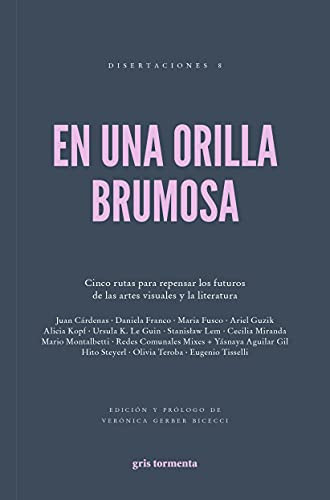
En una orilla brumosa: cinco rutas para repensar los futuros de las artes visuales y la literatura
Sobre En una orilla brumosa: cinco rutas para repensar los futuros de las artes visuales y la literatura
Originating from nine countries, these thirteen voices imagine and explore the futures of writing and its relationship to the visual arts through speculative essays. The anthology traces five paths for reading--autonomous and unintelligible writings, non-human writings, migrant writings, antonymous writings, and unearthed writings--which, from a misty shore, explore the boundaries of disciplines, image, text, speculative imagination, and the future itself to rethink the tools with which we think and make art. Filmmaker, philosopher and cultural critic Hito Steyerl (Munich 1966, lives and works in Berlin) explores the world's oldest temple on his smartphone. Noted author and philosopher Stanislaw Lem (Lwów,interwar Poland (nowLviv,Ukraine) 1921-2006) teaches a colony of bacteria to speak. Painter Juan Cárdenas (Popayán, Colombia 1978) tells the story of a city infected by strange language architectures. Spanish author and artist Alicia Kopf (the pseudonym of Imma Ávalos Marqués, born Gerona, Spain 1982, lives in Barcelona), engages in platonic dialogue with a robot. Syntactician and a professor of linguistics Mario Montalbetti (Callao, Peru 1953) crosses the border from the verbal to the visual. Writer, lecturer, art critic Maria Fusco (Belfast, Northern Ireland 1972) frantically cannibalizes a list of hegemonic visual artists. Programmer and digital artist Eugenio Tisselli (Mexico, lives and works in Spain) transcribes a conversation of the end of the world. Musician, draftsman and illustrator Ariel Guzik (Mexico) invents an instrument, an underwater poem, to communicate with whales. Conceptual artist Daniela Franco (Mexico) states that the future is now. Yásnaya Aguilar Gil (Ayutla Mixe, Oaxaca) imagine that the arts survive a capitalist apocalypse. Cecilia Miranda observes the world at ground level. Olivia Teroba (Tlaxcala, 1988) turns to heaven and narrates his genealogy of scriptures. Ursula K. Le Guin (USA 1929) suggests the creation of a new world from the worlds we have lost.
¿Cuántas páginas tiene En una orilla brumosa: cinco rutas para repensar los futuros de las artes visuales y la literatura?
Esta edición de En una orilla brumosa: cinco rutas para repensar los futuros de las artes visuales y la literatura tiene 228 páginas. El tiempo para terminarlo depende de cuántas páginas leas al día.
20 páginas al día
~12 días
30 páginas al día
~8 días
50 páginas al día
~5 días
Es una estimación por ritmo diario, no por velocidad en palabras por minuto.
Calcula cuánto tardarías tú en leerlo →Temas y géneros
Guárdalo, registra tu progreso y compártelo con otros lectores.
La actividad de la comunidad aparecerá aquí cuando exista suficiente señal para que sea útil.